
🎥🤖 Generative AI in Radiology: Promise, Progress, and Practical Limits
Reviews of recent studies show that generative AI can support radiology workflows, but safety and reliability remain central concerns.
Why This Study Matters
Radiology produces vast amounts of imaging data. Generative AI models could help reconstruct images, assist reporting, or reduce scan time. This article summarizes what current research says about where generative AI helps—and where caution is needed.
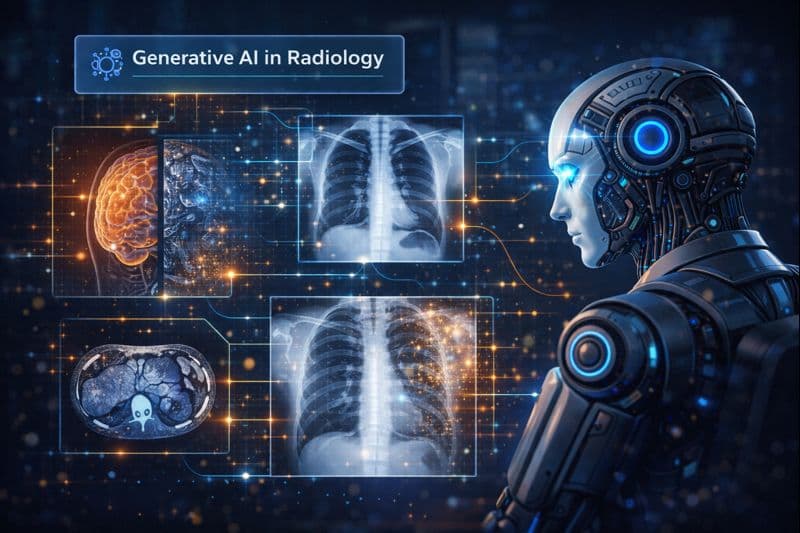
What Researchers Reviewed
Researchers reviewed studies applying generative models in radiology.
Generative AI creates new data that resembles real data, such as medical images.
Key application areas include:
- Image reconstruction and enhancement
- Synthetic data generation
- Report drafting assistance
Study Summary
| Aspect | Details |
|---|---|
| Study Type | Systematic and narrative reviews |
| Models | GANs and diffusion-based models |
| Applications | Imaging, reporting, data augmentation |
| Focus | Performance and safety |
Real Data Highlights
- Improved image quality in reconstruction tasks
- Reduced scan time in controlled settings
- Useful synthetic data for training
- Risk of hallucinated or misleading outputs
Key Insights
- Efficiency Gains: Faster imaging workflows possible.
- Data Support: Synthetic data can help training.
- Safety First: Errors in medical AI carry high risk.
Real-World Benefits
| Scenario | Potential Benefit |
|---|---|
| Imaging pipelines | Faster reconstruction |
| Model training | Augmented datasets |
| Clinical reporting | Draft assistance |
Limitations
- Risk of generating incorrect medical details
- Requires strong validation and oversight
- Regulatory approval remains complex
Summary
Generative AI shows promise in radiology, but its use must remain carefully controlled and clinically validated.
Sources
- RSNA. Foundation and generative AI in radiology. Radiology. 2024.
Disclaimer
This article summarizes peer-reviewed research for educational purposes only.