
☁️🌦️ AI Weather Forecasting: Probabilistic Models Match Traditional Systems
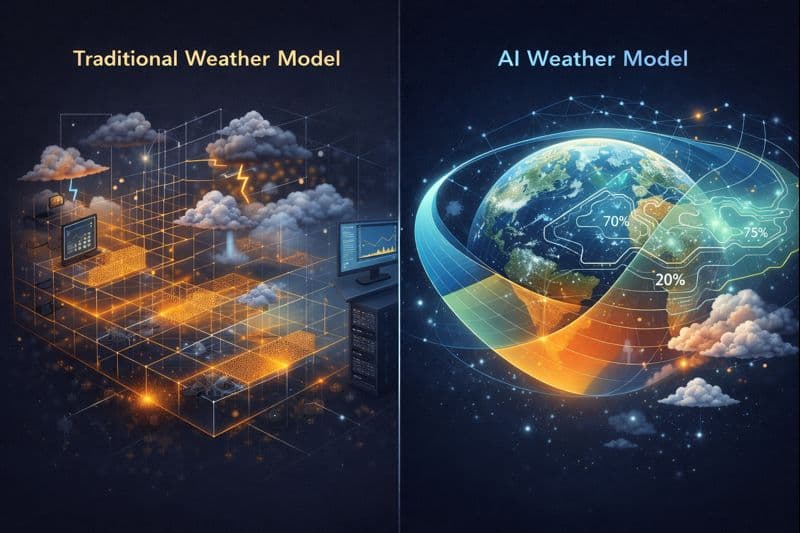
Recent research demonstrates that probabilistic machine-learning models can forecast weather with accuracy similar to traditional ensemble systems—while running significantly faster and using fewer computational resources.
Why This Study Matters
Weather forecasts affect agriculture, disaster response, aviation, and everyday planning. Traditional weather prediction relies on complex physical simulations that require massive computing power. This study explores whether AI models trained on historical weather data can provide accurate forecasts while also estimating uncertainty.
What Researchers Proposed
Researchers developed a probabilistic AI weather forecasting model trained on decades of global atmospheric data.
Probabilistic models predict a range of possible outcomes rather than a single value, helping estimate forecast confidence.
Key features include:
- Learning patterns from historical weather observations
- Predicting probability distributions for key variables
- Producing forecasts much faster than physics-based models
Study Summary
| Aspect | Details |
|---|---|
| Data | Global atmospheric reanalysis datasets |
| Model Type | Probabilistic machine-learning model |
| Forecast Scope | Short- to medium-range forecasts |
| Benchmark | Traditional ensemble forecasting systems |
Real Data Highlights
- Forecast accuracy comparable to leading ensemble systems
- Reliable uncertainty estimates for temperature and pressure
- Forecast generation reduced from hours to seconds
- Consistent performance across multiple weather variables
Key Insights
- Speed Advantage: AI models generate forecasts far more quickly.
- Uncertainty Awareness: Probabilistic outputs help assess confidence.
- Complementary Role: AI can support, not replace, physical models.
Real-World Benefits
| Scenario | AI Advantage |
|---|---|
| Disaster planning | Faster risk-aware forecasts |
| Climate services | Lower computational cost |
| Local forecasting | Rapid updates |
Limitations
- Performance depends on historical data quality
- Rare and extreme events remain challenging
- Not a full replacement for physical simulations
Summary
Probabilistic AI weather models show strong promise as efficient forecasting tools, offering speed and uncertainty estimation while maintaining accuracy comparable to traditional systems.
Sources
- Pathak et al. Probabilistic machine learning for weather forecasting. Nature. 2025.
Disclaimer
This article summarizes peer-reviewed research for educational purposes only.